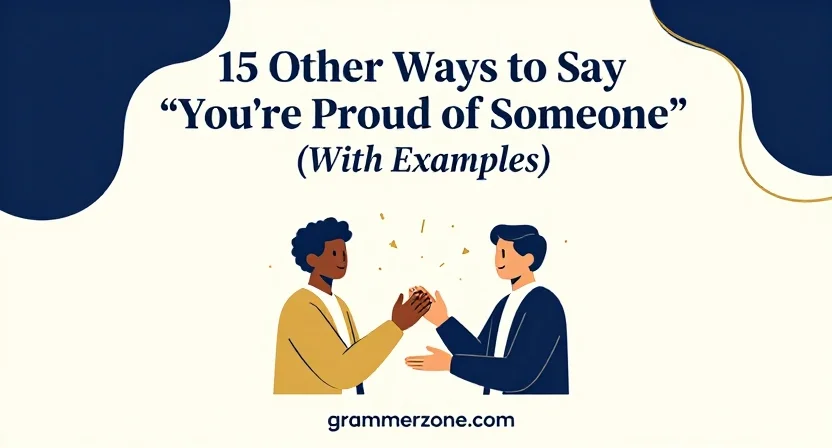
You’re Proud of Someone when a person you care about reaches a goal, and your words can express pride, admiration, appreciation, and happiness. When someone accomplishes something great, the wonderful feeling can make you want to express how proud you feel about their achievements and growth. It can be challenging to find the right words that capture your pride without sounding repetitive or cliché. Rather than using I’m so proud of you as your default phrase, you can choose impactful ways to get across a heartfelt sentiment. A sincere compliment communicates admiration, appreciation, and encouragement, while the right expression can sound warmer, more personal, and enthusiastic within any relationship.
Explore synonyms, natural alternatives, meanings, examples, and tones to make your expressions of pride more meaningful and memorable. A variety of options lets you choose phrases that feel authentic, fit the specifics of an accomplishment, and provide sincere praise. A major milestone may deserve words that highlight an impressive effort. A small personal victory may need simple words that recognize what someone did well. Diverse vocabulary gives you a useful toolbox of different ways to say what you feel. Celebrating another person’s achievement with the right phrase can show that you notice the effort behind the result and share their genuine happiness.
A list of alternatives enables you to keep messages fresh and thoughtful through varying your language. It adds depth, sincerity, and care when you compliment loved ones, help them feel your pride, or help them understand the reasons behind it. Practical guidance can help you master expressing your pride in a natural way. The goal is to find heartfelt, unique ways to celebrate a particular achievement while keeping your message natural. This post gives you powerful options to try out and choose according to the wording that best reflects your personal connection and happiness.
What Does “You’re Proud of Someone” Mean?
“You’re proud of someone” means you feel pleased, happy, or deeply satisfied because of another person’s actions, achievements, character, or progress. The phrase often suggests that the person has done something admirable or meaningful, such as succeeding at school, reaching a career goal, overcoming a challenge, or behaving courageously. For example, if a friend finishes a difficult degree, you might say that you’re proud of them because their achievement makes you feel happy and appreciative of their effort.
The expression can communicate more than simple approval. Pride often carries an emotional connection, especially when you care about the person involved. A parent may feel proud of a child’s progress, a manager may be proud of an employee’s work, or a friend may feel proud when someone close to them reaches an important goal. Depending on the wording, the same basic idea can sound warm, emotional, enthusiastic, respectful, or professional.
Common Situations Where “You’re Proud of Someone” Is Used
People use this idea most often in personal conversations when someone has accomplished something worth celebrating. You might tell a friend, “I’m really proud of you,” after they complete a difficult project, make a brave decision, or achieve a personal goal. Parents, partners, siblings, and close friends commonly use this kind of language because it expresses both admiration and emotional support.
It also works in school and workplace settings, although the wording may need to change. A teacher might say, “You should be proud of your progress,” while a manager could say, “I’m impressed by the work you’ve accomplished.” In professional communication, expressions focused on achievement, effort, and results can sound more appropriate than highly emotional language.
You may also want an alternative in texts, social media posts, cards, speeches, and personal messages. Repeating “I’m proud of you” can sometimes feel predictable. A different expression can make your message more specific and show exactly what you admire about the person.
Is It Professional or Polite to Say “You’re Proud of Someone”?
The underlying idea is polite and positive, but the exact wording determines how professional it sounds. “I’m proud of you” is completely natural in personal communication, especially between people who know each other well. However, in a workplace, it can sometimes sound more personal or emotionally intimate than necessary, depending on the relationship and the culture of the organization.
For professional situations, expressions such as “I’m impressed by your work,” “You’ve done an excellent job,” or “Your hard work has really paid off” may communicate admiration while keeping the focus on performance. In a close relationship, however, a warmer expression such as “I couldn’t be prouder of you” can feel more sincere and emotionally powerful. Context matters more than a simple formal-versus-informal rule.
Advantages and Disadvantages of Saying “You’re Proud of Someone”
Advantages
The main advantage is its emotional clarity. Saying that you’re proud of someone tells them that their achievement matters to you. It can also provide encouragement during an important moment, especially when the person has worked hard or overcome something difficult. The expression is familiar, easy to understand, and suitable for many personal situations.
Another benefit is that pride can recognize more than a final result. You can be proud of someone’s effort, growth, courage, character, or persistence, even when they haven’t achieved a traditional milestone. That makes the expression useful for supportive communication.
Disadvantages
The phrase can sometimes be too general if you don’t explain what you admire. “I’m proud of you” is warm, but adding a specific reason can make the message much more meaningful. For example, “I’m proud of how patiently you handled that situation” tells the person exactly what stood out to you.
It may also feel too personal or emotional in some professional contexts. In those situations, a phrase that focuses on the person’s work, progress, or accomplishment may communicate the same positive feeling more naturally.
15 Natural Alternatives to “You’re Proud of Someone”
- I’m proud of you.
- I couldn’t be prouder of you.
- You should be proud of yourself.
- I’m really impressed by what you’ve accomplished.
- You’ve done an amazing job.
- You’ve made me proud.
- I’m so happy for you.
- You have every reason to be proud.
- I admire what you’ve achieved.
- Your hard work has really paid off.
- You did yourself proud.
- I’m pleased with how far you’ve come.
- You’ve come a long way.
- I’m genuinely impressed with you.
- I couldn’t be happier with what you’ve achieved.
1. I’m proud of you.
Meaning
“I’m proud of you” directly tells another person that their actions, progress, achievement, or character have made you feel proud and pleased. It is one of the most natural ways to express the central idea behind “you’re proud of someone.”
Definition
I’m proud of you means I feel proud because of what you have done or the person you have become.
Detailed Explanation
This expression is personal, warm, and emotionally direct. It works especially well when you have a meaningful relationship with the person, such as a friend, family member, partner, or mentor. Unlike a general compliment, it communicates that their achievement has affected you personally. It can recognize major accomplishments or quiet personal growth.
Scenario Examples
Scenario: Your friend finally finishes a course they have struggled with.
Example: “You stuck with it even when it got difficult. I’m really proud of you.”
Scenario: A family member gets through a challenging period.
Example: “You handled everything with so much strength. I’m proud of you.”
Best Use
Best for personal messages, conversations, supportive texts, family communication, friendships, and close relationships.
Tone
Tone: Warm, personal, supportive
It feels sincere because it connects the speaker’s positive feeling directly to the other person.
2. I couldn’t be prouder of you.
Meaning
“I couldn’t be prouder of you” expresses an especially strong sense of pride. It suggests that the speaker’s feelings of pride are extremely high.
Definition
It means I feel an enormous amount of pride because of what you have done.
Detailed Explanation
This phrase is stronger and more emotional than a simple “I’m proud of you.” It is often used for major milestones or deeply meaningful moments, such as graduation, overcoming a serious challenge, or achieving a long-term goal. The wording is emphatic without being negative; “couldn’t be prouder” means the speaker cannot imagine feeling any more proud.
Scenario Examples
Scenario: Your sibling graduates after years of hard work.
Example: “After everything you’ve put into this degree, I couldn’t be prouder of you.”
Scenario: Your child performs confidently at an important event.
Example: “You walked onto that stage and gave it everything. I couldn’t be prouder of you.”
Best Use
Best for major achievements, emotional celebrations, family milestones, graduation messages, and heartfelt conversations.
Tone
Tone: Deeply warm, emotional, enthusiastic
The expression has more emotional intensity than the basic phrase.
3. You should be proud of yourself.
Meaning
“You should be proud of yourself” encourages the other person to recognize their own accomplishment. Instead of focusing on the speaker’s feelings, it puts the attention on the person’s self-confidence and achievement.
Definition
It means you have done something worthy of feeling proud about.
Detailed Explanation
This alternative is useful when someone is being too hard on themselves or doesn’t fully appreciate what they have achieved. It can sound encouraging and empowering because you’re reminding them to give themselves credit. It differs from “I’m proud of you” because the emotional focus shifts from the speaker to the person’s own feelings.
Scenario Examples
Scenario: A student worries that their exam result wasn’t perfect.
Example: “You improved your score by 20 points. You should be proud of yourself.”
Scenario: A friend completes their first marathon.
Example: “You trained for months and finished the race. You should be proud of yourself.”
Best Use
Best for encouragement, personal conversations, coaching, school, friendships, and supportive messages.
Tone
Tone: Encouraging, supportive, empowering
It helps someone recognize their own progress rather than depending entirely on outside approval.
4. I’m really impressed by what you’ve accomplished.
Meaning
This expression communicates strong admiration for a person’s achievement. It focuses more on what they have accomplished than on the emotional concept of pride itself.
Definition
It means I admire the results or achievements you have reached.
Detailed Explanation
This is a useful alternative when you want to sound respectful and slightly more professional. It works particularly well when discussing career achievements, academic success, projects, or measurable progress. While “I’m proud of you” highlights emotional connection, “I’m impressed” highlights admiration for ability, effort, or results.
Scenario Examples
Scenario: A colleague successfully leads a complicated project.
Example: “I’m really impressed by what you’ve accomplished with the project.”
Scenario: Your friend builds a successful small business.
Example: “You started with an idea and turned it into a real business. I’m really impressed by what you’ve accomplished.”
Best Use
Best for workplace communication, professional conversations, academic settings, networking, and respectful personal compliments.
Tone
Tone: Respectful, positive, professional
It expresses admiration without sounding overly intimate.
5. You’ve done an amazing job.
Meaning
“You’ve done an amazing job” praises the quality of someone’s work or performance. It emphasizes what the person did well rather than explicitly describing the speaker’s feeling of pride.
Definition
It means you performed or completed something extremely well.
Detailed Explanation
This is one of the most flexible alternatives because it can be used for small accomplishments as well as major projects. It is usually more focused on performance and results than “I’m proud of you.” You can also use it immediately after someone completes a task, making it particularly natural in everyday conversation.
Scenario Examples
Scenario: Your friend organizes a difficult event.
Example: “You handled all those last-minute changes and still kept everything running. You’ve done an amazing job.”
Scenario: A coworker presents a new idea to the team.
Example: “You explained the proposal clearly. You’ve done an amazing job.”
Best Use
Best for work, school, everyday conversation, personal messages, presentations, projects, and encouragement.
Tone
Tone: Positive, enthusiastic, friendly
It sounds natural without being excessively emotional.
6. You’ve made me proud.
Meaning
“You’ve made me proud” tells someone that their behavior or achievement has caused the speaker to feel personal pride.
Definition
It means what you have done has made me feel proud of you.
Detailed Explanation
This expression is close to “I’m proud of you,” but it places greater emphasis on the effect the person’s actions have had on the speaker. It can sound especially heartfelt when used by parents, mentors, teachers, or people in close relationships. Because of its emotional weight, it can feel more significant than an ordinary compliment.
Scenario Examples
Scenario: A student helps another student who is struggling.
Example: “You didn’t just finish your assignment; you stayed to help someone else. You’ve made me proud.”
Scenario: Your younger sibling handles a difficult situation maturely.
Example: “You stayed calm and treated everyone respectfully. You’ve made me proud.”
Best Use
Best for family relationships, mentoring, personal conversations, heartfelt messages, and meaningful achievements.
Tone
Tone: Warm, heartfelt, personal
The phrase emphasizes the emotional connection between the speaker and the person being praised.
7. I’m so happy for you.
Meaning
“I’m so happy for you” expresses genuine happiness about another person’s good news, success, or positive life event.
Definition
It means your happiness or success makes me happy too.
Detailed Explanation
This phrase is related to pride but isn’t an exact substitute in every situation. It focuses on sharing someone’s happiness rather than specifically admiring their accomplishment. It works particularly well for personal milestones such as engagements, new jobs, graduations, awards, or other exciting news.
Scenario Examples
Scenario: Your friend gets the job they wanted.
Example: “You worked so hard for this opportunity. I’m so happy for you!”
Scenario: A close friend announces an engagement.
Example: “That’s wonderful news. I’m so happy for you both.”
Best Use
Best for celebrations, personal news, friendships, family messages, social media, and joyful conversations.
Tone
Tone: Warm, joyful, celebratory
It communicates shared happiness rather than emphasizing admiration alone.
8. You have every reason to be proud.
Meaning
“You have every reason to be proud” tells someone that their achievement or behavior clearly deserves recognition.
Definition
It means your accomplishment is genuinely worthy of pride.
Detailed Explanation
This expression is useful when you want to encourage someone without making the statement entirely about your own feelings. It can sound reassuring when someone doubts whether their accomplishment is significant. Compared with “I’m proud of you,” it gives the person permission or encouragement to recognize their own success.
Scenario Examples
Scenario: A colleague finishes a difficult assignment after several revisions.
Example: “The final report is excellent. You have every reason to be proud.”
Scenario: A student improves significantly during the school year.
Example: “Look at how much you’ve improved since September. You have every reason to be proud.”
Best Use
Best for encouragement, professional praise, school, mentoring, personal conversations, and reflective messages.
Tone
Tone: Reassuring, respectful, encouraging
It sounds supportive without being overly emotional.
9. I admire what you’ve achieved.
Meaning
“I admire what you’ve achieved” communicates respect and appreciation for someone’s accomplishments.
Definition
It means I have genuine respect for what you have accomplished.
Detailed Explanation
This expression is slightly more formal and thoughtful than “I’m proud of you.” It focuses on admiration and respect, making it useful when you don’t have a deeply personal relationship with the person. It can recognize professional, academic, creative, or personal achievements without implying that the speaker has a parental or intimate role.
Scenario Examples
Scenario: A professional builds a career after changing fields.
Example: “Changing careers and starting over takes courage. I admire what you’ve achieved.”
Scenario: Someone completes a demanding creative project.
Example: “The book reflects years of work. I genuinely admire what you’ve achieved.”
Best Use
Best for professional communication, speeches, formal compliments, networking, academic settings, and respectful personal conversations.
Tone
Tone: Respectful, thoughtful, appreciative
It carries admiration without sounding overly familiar.
10. Your hard work has really paid off.
Meaning
“Your hard work has really paid off” connects a person’s success directly to the effort they invested.
Definition
It means your effort has produced a successful or worthwhile result.
Detailed Explanation
This expression is especially useful when you know someone has spent a long time working toward a goal. Rather than simply praising the final achievement, it recognizes the process behind it. That makes it a strong choice when you want someone to feel that their persistence and dedication were noticed.
Scenario Examples
Scenario: A friend finally passes a difficult professional exam.
Example: “All those late-night study sessions were worth it. Your hard work has really paid off.”
Scenario: An employee’s long-term project succeeds.
Example: “The launch went better than expected. Your hard work has really paid off.”
Best Use
Best for workplace communication, academic achievements, long-term goals, personal milestones, and encouraging messages.
Tone
Tone: Appreciative, encouraging, sincere
It specifically recognizes effort and persistence, not just the final result.
11. You did yourself proud.
Meaning
“You did yourself proud” means someone performed or behaved in a way that should make them feel proud of themselves.
Definition
It means you performed very well and gave yourself something to be proud of.
Detailed Explanation
This is a natural idiom, especially in British English, and it may sound less familiar to some American English speakers. The phrase focuses on the person’s own performance rather than the speaker’s emotional response. It can be a warm way to praise someone after a performance, competition, presentation, or challenging task.
Scenario Examples
Scenario: A friend gives an important speech.
Example: “You were nervous beforehand, but you handled the questions brilliantly. You did yourself proud.”
Scenario: Someone competes in their first major sporting event.
Example: “You gave it everything you had. You did yourself proud.”
Best Use
Best for spoken English, friendly encouragement, performances, competitions, British English, and personal praise.
Tone
Tone: Warm, encouraging, idiomatic
It feels conversational and emphasizes personal achievement.
12. I’m pleased with how far you’ve come.
Meaning
“I’m pleased with how far you’ve come” expresses satisfaction with someone’s growth, progress, or development over time.
Definition
It means I’m happy and impressed by the progress you have made.
Detailed Explanation
This alternative works especially well when the person’s achievement is about growth rather than one specific event. It can recognize improvement in confidence, skills, education, work, or personal development. The phrase is generally softer than “I couldn’t be prouder of you,” so it can fit situations where a calm, thoughtful response is more appropriate.
Scenario Examples
Scenario: A student has improved their writing over the semester.
Example: “Your essays are much clearer now. I’m really pleased with how far you’ve come.”
Scenario: A new employee becomes more confident over several months.
Example: “You’ve taken on much bigger responsibilities lately. I’m pleased with how far you’ve come.”
Best Use
Best for mentoring, education, workplace feedback, personal development, coaching, and supportive conversations.
Tone
Tone: Encouraging, measured, supportive
It recognizes progress without sounding overly dramatic.
13. You’ve come a long way.
Meaning
“You’ve come a long way” recognizes the distance between someone’s earlier situation and their current progress.
Definition
It means you have made significant progress from where you started.
Detailed Explanation
This expression is particularly effective when the person’s development is visible over time. It can refer to skills, confidence, education, career progress, or personal goals. Because it highlights a journey, it often carries a sense of reflection and encouragement rather than simply praising one achievement.
Scenario Examples
Scenario: A beginner becomes an experienced musician.
Example: “I remember when you were learning your first chords. You’ve come a long way.”
Scenario: A colleague grows into a leadership role.
Example: “You started as an intern, and now you’re leading the team. You’ve come a long way.”
Best Use
Best for long-term progress, mentoring, friendships, education, careers, and personal growth.
Tone
Tone: Reflective, warm, encouraging
It draws attention to the journey as well as the result.
14. I’m genuinely impressed with you.
Meaning
“I’m genuinely impressed with you” expresses sincere admiration for someone’s actions, ability, character, or achievement.
Definition
It means I sincerely admire what you have done or how you have handled yourself.
Detailed Explanation
The word “genuinely” adds sincerity and suggests that the praise isn’t merely polite. This phrase can work when the speaker wants to emphasize that something about the person’s performance or behavior stood out. It is somewhat more direct than “I’m impressed by what you’ve accomplished” because it praises the person rather than focusing only on the result.
Scenario Examples
Scenario: A friend handles a difficult conversation maturely.
Example: “You stayed calm even when things got tense. I’m genuinely impressed with you.”
Scenario: A coworker takes responsibility for solving an unexpected problem.
Example: “You found a solution before anyone else knew there was a problem. I’m genuinely impressed with you.”
Best Use
Best for personal conversations, workplace praise, friendships, professional feedback, and situations involving noticeable skill or maturity.
Tone
Tone: Sincere, appreciative, direct
It sounds heartfelt while remaining suitable for many professional situations.
15. I couldn’t be happier with what you’ve achieved.
Meaning
“I couldn’t be happier with what you’ve achieved” expresses an extremely positive reaction to another person’s accomplishment.
Definition
It means I am extremely pleased and happy about your achievement.
Detailed Explanation
This phrase emphasizes happiness and satisfaction rather than pride alone. It works well when someone has reached an important goal and you want to communicate strong enthusiasm. Because “couldn’t be happier” is highly positive, it is most natural for significant accomplishments or moments that genuinely matter to the speaker.
Scenario Examples
Scenario: A family member graduates after overcoming financial difficulties.
Example: “You worked through so many obstacles to get here. I couldn’t be happier with what you’ve achieved.”
Scenario: A team completes a successful project.
Example: “Everyone put in tremendous effort, and I couldn’t be happier with what you’ve achieved.”
Best Use
Best for major achievements, celebrations, heartfelt messages, team accomplishments, family milestones, and congratulatory communication.
Tone
Tone: Joyful, enthusiastic, heartfelt
It communicates strong positive emotion and satisfaction with the outcome.
See also: 15 Other Ways to Say “Mark Your Calendars” (With Examples)
FAQs:
What is another way to say “You’re proud of someone”?
Natural alternatives include “I’m proud of you,” “I’m really impressed by what you’ve accomplished,” “You’ve made me proud,” and “You should be proud of yourself.” The best choice depends on whether you want to emphasize personal pride, admiration, encouragement, or the person’s own sense of achievement.
What does “You’re proud of someone” mean?
It means you feel happy, pleased, or deeply satisfied because of another person’s achievement, behavior, progress, or character. The expression often carries an emotional connection and is commonly used with family members, friends, partners, students, or people you mentor.
Is “You’re proud of someone” professional?
The underlying sentiment is positive and polite, but the exact wording can be more personal than professional in some situations. At work, phrases such as “I’m impressed by your work” or “You’ve done an excellent job” may fit better because they focus directly on performance or achievement.
What is a more polite way to say “You’re proud of someone”?
Several expressions can sound polite and respectful, including “I admire what you’ve achieved,” “I’m really impressed by your work,” and “You have every reason to be proud.” These choices are useful when you want to praise someone without sounding overly familiar.
Which alternative works best in formal communication?
“I’m really impressed by what you’ve accomplished” and “I admire what you’ve achieved” are strong choices for formal or professional communication. They communicate respect and appreciation while keeping the focus on the person’s achievement rather than creating an overly personal tone.
Conclusion:
Choosing another way to express pride can make your message feel more specific, sincere, and appropriate to the situation. “I’m proud of you” is warm and personal, while “I’m impressed by what you’ve accomplished” can work better in professional communication. Expressions such as “Your hard work has really paid off” recognize effort, while “You’ve come a long way” highlights growth over time.The key is to consider who you’re speaking to, what they achieved, and the emotion you want to communicate. If you’re talking to someone close to you, a heartfelt phrase may mean the most.