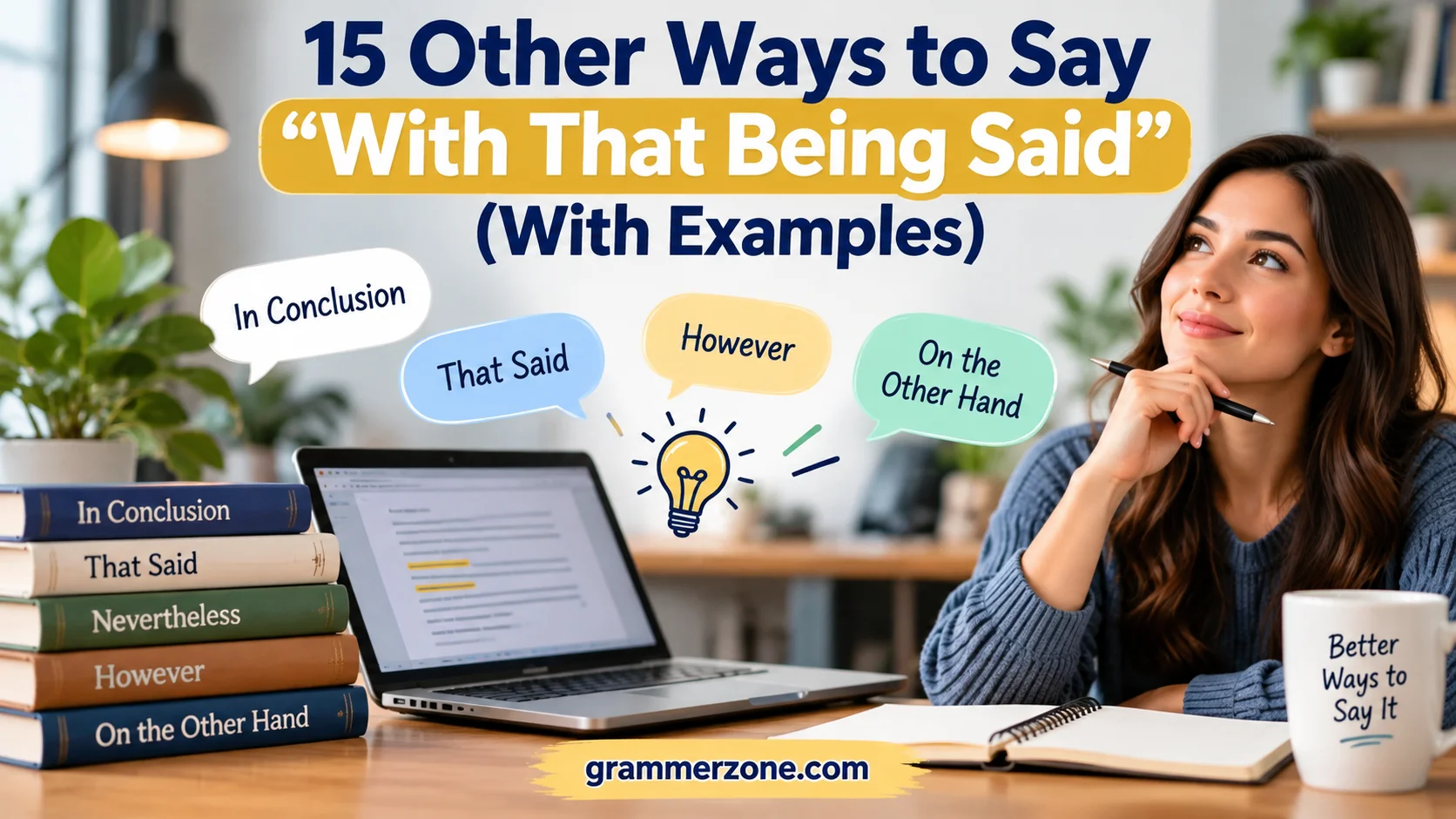
The keyword Other Ways to Say “With That Being Said” helps you find suitable alternatives for clearer communication and natural writing. Small wording choices can connect two ideas, show a changing direction, and keep your message lively instead of predictable or repetitive. With that being said is a common phrase used in conversation, speaking, and writing, but repeated use can sound canned. Creative ways to replace it can soften a disagreement without dismissing the point that came before.
These expressions offer 15 other ways to adjust your tone, wording, writing style, and meaning while keeping your language natural and polished. The right alternative depends on the context, sentence, and language. Close substitutes, synonyms, and alternative phrases can emphasize contrast, support a new consideration, or pivot toward another idea. Meanings, definitions, and realistic examples help you understand each substitution and emphasis.
A conversational tone can suit a chat with friends, while a professional tone works well in an email, speech, or business message. Effective wording can sound smoothly and keep the audience interested. A useful guide can help you connect thoughts, change direction, and add stylistic flair through natural language. More variety in your vocabulary reduces overuse and makes communication feel more engaging. Whether composing a speech, improving writing, or having a conversation, you can learn when to apply these choices and use the right examples with confidence.
What Does “With That Being Said” Mean?
“With that being said” is a transitional expression used to introduce a statement that follows, qualifies, contrasts with, or adds context to something just mentioned. It often signals that the speaker accepts or acknowledges the previous point but wants to present another perspective. For example, you might say, “The restaurant is expensive. With that being said, the food is excellent.” The phrase tells the listener that the second statement should be considered alongside the first rather than treated as a complete contradiction.
The expression is closely related to “that said” and “having said that.” It can also introduce a conclusion or shift in emphasis: “The project was difficult. With that being said, we learned a lot from it.” In everyday English, the phrase is generally understood as a way to balance ideas. Depending on the context, it can sound conversational, thoughtful, or moderately formal.
Common Situations Where “With That Being Said” Is Used
People commonly use “with that being said” when they want to acknowledge one idea before introducing another. In everyday conversation, someone might say, “I don’t love the color. With that being said, it looks good in this room.” The expression makes the shift feel less abrupt.
It also appears frequently in workplace communication and formal writing. A manager might write, “The proposal needs some revisions. With that being said, the overall concept is strong.” In a discussion, presentation, email, essay, or social media post, the phrase can help connect two thoughts that aren’t necessarily identical.
The main reason to choose an alternative is variety and precision. Sometimes “that said” sounds cleaner. In other cases, “however” creates a sharper contrast, while “with that in mind” indicates that the previous information should guide the next decision. Choosing the right expression helps you communicate the exact relationship between your ideas.
Is It Professional or Polite to Say “With That Being Said”?
Yes, “with that being said” can be both polite and professional, depending on how you use it. It doesn’t carry an inherently rude or informal meaning. In professional conversations, it can help you acknowledge another person’s point before presenting a qualification or different perspective.
However, the phrase can become somewhat wordy or repetitive in formal writing, especially when it appears several times in the same document. A concise alternative such as “that said,” “however,” or “nevertheless” may create a cleaner sentence. In casual conversation, the original expression is perfectly understandable and natural.
Its tone is generally balanced and diplomatic. Rather than abruptly saying “but,” you can use it to show that you haven’t ignored the previous point. Still, the exact tone comes from the surrounding sentence, so the expression doesn’t automatically make criticism polite.
Advantages and Disadvantages of Saying “With That Being Said”
Advantages
One advantage is that “with that being said” clearly signals a transition. Readers or listeners immediately understand that another point is coming. It can also create a sense of balance because it acknowledges what was said previously before introducing a qualification. This makes it useful when you want to disagree or add a different perspective without making the transition feel abrupt.
The phrase is also flexible. You can use it in conversations, emails, presentations, essays, reviews, and other forms of communication. Its meaning is usually easy for English speakers to understand.
Disadvantages
The main limitation is that it can become wordy or repetitive. If every paragraph uses “with that being said,” the expression can start to sound formulaic. In some sentences, “that said” communicates the same relationship more efficiently.
Another limitation is that it doesn’t always describe the exact relationship between two ideas. If you mean a strong contrast, “however” may be more precise. If you’re referring back to information that should influence a decision, “with that in mind” may be a better choice. The best alternative depends on the context.
15 Synonyms and Alternatives for “With That Being Said”
- That said
- That being said
- Having said that
- With that in mind
- However
- Nevertheless
- Nonetheless
- Even so
- Still
- On the other hand
- At the same time
- All that being said
- With this in mind
- Given that
- In light of that
1. That said
Meaning
“That said” means that the speaker acknowledges the previous point but is about to introduce a different, qualifying, or contrasting idea.
Definition
That said is a concise transitional phrase meaning “despite what was just mentioned” or “considering the previous point.”
Detailed Explanation
This is one of the closest and most natural alternatives to “with that being said.” It performs essentially the same conversational job but is shorter and more direct. It works especially well in professional writing because it doesn’t add unnecessary words. When you want a smooth transition without sounding overly formal, this is often a strong choice.
Scenario Examples
Scenario: You’re reviewing a coworker’s proposal.
Example: “The proposal needs more detail. That said, the central idea is promising.”
Scenario: You’re discussing a movie with a friend.
Example: “The ending was predictable. That said, I still enjoyed the film.”
Best Use
Use “that said” in emails, essays, reviews, workplace communication, and everyday conversation when you want a concise transition.
Tone: Polished, balanced, and conversational. It sounds natural without being overly casual.
2. That being said
Meaning
“That being said” acknowledges the previous statement before introducing another point, often one that qualifies or contrasts with it.
Definition
That being said is a transitional expression meaning roughly “despite that” or “considering what was just said.”
Detailed Explanation
This phrase is extremely close in meaning to “with that being said.” In many contexts, you can substitute one for the other without changing the basic message. It can sound slightly more deliberate because it explicitly refers to the statement that came before. It’s useful when you want to show that your next point doesn’t completely erase or reject the previous one.
Scenario Examples
Scenario: You’re giving feedback to a colleague.
Example: “The presentation was longer than expected. That being said, the information was valuable.”
Scenario: You’re talking about a difficult course.
Example: “The class requires a lot of reading. That being said, the professor explains everything clearly.”
Best Use
It fits conversation, professional communication, essays, reviews, and personal writing.
Tone: Neutral, thoughtful, and balanced. It emphasizes a deliberate shift between ideas.
3. Having said that
Meaning
“Having said that” means that after acknowledging one statement, you’re adding another point that may qualify, contrast with, or slightly change the emphasis.
Definition
Having said that is a transitional expression used to introduce a qualification after a previous statement.
Detailed Explanation
This phrase is another close alternative to “with that being said.” It often sounds natural when someone has just expressed an opinion and wants to add a reservation. It can be particularly effective in spoken English because it sounds like a natural continuation of thought. The expression doesn’t necessarily mean that the second point completely contradicts the first.
Scenario Examples
Scenario: You’re discussing a new employee.
Example: “She still needs training in a few areas. Having said that, she has learned quickly.”
Scenario: You’re giving your opinion about a purchase.
Example: “The laptop is expensive. Having said that, its battery life is excellent.”
Best Use
Use it in conversation, interviews, reviews, personal opinions, and workplace discussions.
Tone: Thoughtful, conversational, and mildly formal. It works well when you want to sound measured rather than abrupt.
4. With that in mind
Meaning
“With that in mind” means that the information just discussed should be considered when thinking about what comes next.
Definition
With that in mind means “considering what we now know” or “taking that information into account.”
Detailed Explanation
This expression isn’t an exact synonym for “with that being said.” Its focus is different: instead of simply introducing a contrasting thought, it tells the reader that the previous information should influence the next idea or decision. It’s especially useful when moving from facts to recommendations. That makes it valuable in practical and professional communication.
Scenario Examples
Scenario: You’re planning a team meeting.
Example: “Several employees are working remotely. With that in mind, let’s hold the meeting online.”
Scenario: You’re choosing a hotel.
Example: “We’ll be traveling with young children. With that in mind, a hotel near the beach would be convenient.”
Best Use
It works well in professional emails, planning, recommendations, reports, and decision-making.
Tone: Practical, thoughtful, and professional. It connects previous information directly to a later decision.
5. However
Meaning
“However” introduces a statement that contrasts with or qualifies the previous statement.
Definition
However is a transition meaning “despite that” or “in contrast to what was just stated.”
Detailed Explanation
“However” is more direct than “with that being said.” It clearly tells the reader that the next idea has a contrastive relationship with the previous one. Because it is concise, it works particularly well in formal and academic writing. It can also sound natural in conversation when the contrast is clear.
Scenario Examples
Scenario: You’re writing a product review.
Example: “The camera is compact and lightweight. However, its low-light performance is limited.”
Scenario: You’re discussing a schedule.
Example: “I can attend the meeting. However, I’ll need to leave by four.”
Best Use
Use “however” in formal writing, business communication, academic work, reports, and everyday speech.
Tone: Direct, neutral, and professional. It makes contrast clearer than the longer original phrase.
6. Nevertheless
Meaning
“Nevertheless” introduces a point that remains true despite something previously mentioned.
Definition
Nevertheless means “despite that” or “even so.”
Detailed Explanation
This word creates a stronger sense of persistence despite an obstacle or contrary fact. Compared with “with that being said,” it can sound more formal and deliberate. It works best when the second statement remains valid even though the first statement might suggest otherwise. It isn’t necessary for every mild contrast because it can sound too formal in casual conversation.
Scenario Examples
Scenario: You’re describing a challenging project.
Example: “We had several technical problems. Nevertheless, we completed the project on time.”
Scenario: You’re writing a formal review.
Example: “The evidence is limited. Nevertheless, the findings deserve further consideration.”
Best Use
Best suited to formal writing, reports, academic contexts, and serious discussions.
Tone: Formal, firm, and measured. It emphasizes that something remains true despite a difficulty.
7. Nonetheless
Meaning
“Nonetheless” introduces an idea that remains valid despite the previous point.
Definition
Nonetheless means “despite what has just been said” or “even so.”
Detailed Explanation
“Nonetheless” is very similar to “nevertheless.” It can replace “with that being said” when the purpose is to acknowledge a limitation while emphasizing a continuing point. The word has a polished quality and is more common in formal or carefully edited writing than in casual texting. Use it when you want the contrast to feel clear but not dramatic.
Scenario Examples
Scenario: You’re evaluating a proposal.
Example: “The budget is tight. Nonetheless, the project remains achievable.”
Scenario: You’re discussing a difficult experience.
Example: “The journey was exhausting. Nonetheless, we were glad we went.”
Best Use
Use it in formal writing, business documents, reports, essays, and professional discussions.
Tone: Polished, formal, and composed. It creates a clear but controlled contrast.
8. Even so
Meaning
“Even so” means that the next statement remains true despite the situation just described.
Definition
Even so is an expression meaning “despite that” or “in spite of what was just mentioned.”
Detailed Explanation
This phrase is shorter and more conversational than “with that being said.” It works particularly well when you want to acknowledge a problem but point out that it doesn’t change your overall position. Compared with “nevertheless,” it usually feels less formal. It can also add a subtle sense of emphasis to the following statement.
Scenario Examples
Scenario: A friend is hesitant about attending an event.
Example: “It might be crowded. Even so, I think we’d have a great time.”
Scenario: You’re discussing a difficult assignment.
Example: “The instructions were confusing. Even so, we managed to finish it.”
Best Use
It works best in casual conversation, personal messages, informal writing, and friendly discussions.
Tone: Casual, confident, and conversational. It sounds natural when you’re balancing a concern with a positive or continuing point.
9. Still
Meaning
“Still” can introduce a thought that remains true despite something that was just said.
Definition
As a transition, still means approximately “despite that” or “even after considering the previous point.”
Detailed Explanation
“Still” is one of the most natural choices for everyday speech. It’s much shorter than “with that being said,” so it keeps conversations moving without sounding formal. The word can also sound more personal because it often expresses the speaker’s continuing opinion or feeling. However, it doesn’t always work as a direct replacement when a formal transition is required.
Scenario Examples
Scenario: You’re deciding whether to go out.
Example: “It’s supposed to rain tonight. Still, I’d like to go.”
Scenario: You’re talking about an expensive restaurant.
Example: “The prices are high. Still, the portions are generous.”
Best Use
Use “still” in casual conversation, texting, personal messages, and informal writing.
Tone: Casual, natural, and personal. It sounds like ordinary spoken English rather than formal prose.
10. On the other hand
Meaning
“On the other hand” introduces a different side, perspective, or consideration related to the previous point.
Definition
On the other hand means “from another perspective” or “considering the opposite side of the issue.”
Detailed Explanation
This expression is useful when you are deliberately comparing two sides of an issue. It can replace “with that being said” when the next idea represents a distinct perspective rather than simply a qualification. It often works best when the previous and following ideas are clearly connected. Because it signals comparison, it shouldn’t be used for every simple transition.
Scenario Examples
Scenario: You’re comparing two apartments.
Example: “The first apartment has more space. On the other hand, the second one is closer to work.”
Scenario: You’re considering a job offer.
Example: “The salary is attractive. On the other hand, the commute would be difficult.”
Best Use
Use it in comparisons, discussions, essays, reviews, decision-making, and workplace communication.
Tone: Balanced, analytical, and neutral. It helps readers recognize that another perspective is being considered.
11. At the same time
Meaning
“At the same time” introduces another point that is true alongside the previous one, often creating a balanced view.
Definition
At the same time means “simultaneously” or, in this context, “while also considering another fact.”
Detailed Explanation
This expression is useful when two ideas can both be true without one completely canceling the other. Unlike “however,” it doesn’t always create a strong contradiction. Instead, it highlights balance and coexistence. That’s why it can be a good alternative when “with that being said” is being used to recognize two sides of the same situation.
Scenario Examples
Scenario: You’re giving feedback to a colleague.
Example: “The report is detailed. At the same time, some sections could be easier to follow.”
Scenario: You’re talking about working from home.
Example: “Working remotely saves commuting time. At the same time, it can feel isolating.”
Best Use
It works well in professional communication, essays, discussions, personal conversations, and balanced arguments.
Tone: Balanced, thoughtful, and neutral. It emphasizes that two considerations can exist together.
12. All that being said
Meaning
“All that being said” signals that after considering everything just discussed, you’re going to add a final qualification, opinion, or contrasting point.
Definition
All that being said means “despite everything just mentioned” or “taking all those points into consideration.”
Detailed Explanation
This phrase is closely related to “with that being said,” but it can place slightly more emphasis on the collection of points that came before. It works especially well after several arguments, observations, or considerations. The expression is more conversational than highly formal. Because of its similarity to the original phrase, use it when you want a variation without changing the basic transition.
Scenario Examples
Scenario: You’re discussing the pros and cons of a vacation destination.
Example: “The flights are expensive, and the hotel rates aren’t cheap. All that being said, I’d still love to visit.”
Scenario: You’re reviewing a complicated proposal.
Example: “There are several risks and some unanswered questions. All that being said, the proposal has real potential.”
Best Use
Best for conversation, reviews, personal writing, presentations, and thoughtful discussions.
Tone: Reflective, conversational, and balanced. It suggests that several previous points have been considered.
13. With this in mind
Meaning
“With this in mind” tells the reader that the information just discussed should influence what comes next.
Definition
With this in mind means “considering this information” or “keeping this point in consideration.”
Detailed Explanation
This expression is closely related to “with that in mind,” but it can refer more directly to an idea, fact, or situation being discussed in the current context. It is not an exact substitute when you simply want to express contrast. Instead, choose it when the previous information provides a basis for an action, recommendation, or conclusion.
Scenario Examples
Scenario: A company is trying to reduce expenses.
Example: “Travel costs have increased significantly. With this in mind, we’ll prioritize virtual meetings.”
Scenario: You’re giving study advice.
Example: “The exam covers several difficult chapters. With this in mind, start reviewing early.”
Best Use
Use it in professional emails, instructions, recommendations, planning, reports, and educational writing.
Tone: Professional, practical, and considerate. It connects information with a sensible next step.
14. Given that
Meaning
“Given that” introduces a statement based on a known fact, circumstance, or condition.
Definition
Given that means “considering the fact that” or “because this particular fact is true.”
Detailed Explanation
This expression differs more significantly from “with that being said.” It doesn’t primarily signal contrast. Instead, it introduces a reason or circumstance that supports the next statement. It’s useful when you want to show why a conclusion or decision follows from something already known. Because it establishes a logical connection, it can make writing more precise.
Scenario Examples
Scenario: You’re explaining a scheduling decision.
Example: “Given that most employees work remotely on Fridays, we’ll hold the meeting online.”
Scenario: You’re discussing a travel plan.
Example: “Given that the roads may be icy, leaving early would be sensible.”
Best Use
Use it in professional communication, formal writing, explanations, recommendations, and logical arguments.
Tone: Reasoned, professional, and direct. It emphasizes the factual basis for what follows.
15. In light of that
Meaning
“In light of that” means that the previous information should be considered when forming an opinion, making a decision, or taking action.
Definition
In light of that means “considering that information or circumstance.”
Detailed Explanation
This phrase is useful when new information changes or influences how you view a situation. It can sometimes replace “with that being said,” but its emphasis is more on reassessment or response to information than simple contrast. It has a somewhat more formal sound than “with that being said.” Use it when you want your wording to feel deliberate and reasoned.
Scenario Examples
Scenario: A company receives new information about a project.
Example: “The supplier has changed its delivery schedule. In light of that, we need to adjust our timeline.”
Scenario: You’re reconsidering a decision after learning something important.
Example: “We didn’t know about the additional cost before. In light of that, we should review the budget.”
Best Use
It works especially well in formal emails, reports, workplace communication, policy discussions, and serious conversations.
Tone: Formal, thoughtful, and analytical. It suggests that new information has a meaningful effect on what comes next.
See also: 15 Other Ways to Say “Please Disregard My Previous Email”
FAQs:
What is another way to say “With That Being Said”?
Some of the closest alternatives are “that said,” “that being said,” and “having said that.” For stronger contrast, “however,” “nevertheless,” or “even so” may be more suitable. The best choice depends on the relationship between your two ideas.
What does “With That Being Said” mean?
“With that being said” is a transition used to acknowledge a previous point before introducing another idea, qualification, or contrasting perspective. It often means something similar to “despite that” or “considering what was just said.”
Is “With That Being Said” professional?
Yes. “With that being said” can be professional and polite, particularly in workplace discussions, presentations, and emails. However, repeated use can make formal writing feel wordy, so shorter options such as “that said” or “however” may sometimes be cleaner.
What is a more polite way to say “With That Being Said”?
There isn’t one universally more polite replacement because the phrase itself isn’t inherently impolite. “Having said that” can sound thoughtful and diplomatic, while “with that in mind” works well when you want to acknowledge information before suggesting an action.
Which alternative works best in formal communication?
For formal communication, “that said,” “however,” “nevertheless,” “nonetheless,” and “in light of that” can all work well, depending on the intended meaning. Choose “however” for direct contrast, “nevertheless” for persistence despite a difficulty, and “in light of that” when new information affects a decision.
Conclusion:
Choosing an alternative to “with that being said” isn’t simply about replacing one phrase with another. The better approach is to consider the relationship between your ideas. Use “that said” for a concise qualification, “however” for clear contrast, “on the other hand” for another perspective, or “with that in mind” when previous information should guide what comes next. More formal choices such as “nevertheless” and “in light of that” can suit professional or carefully structured writing.







1 thought on “15 Other Ways to Say “With That Being Said” (With Examples)”