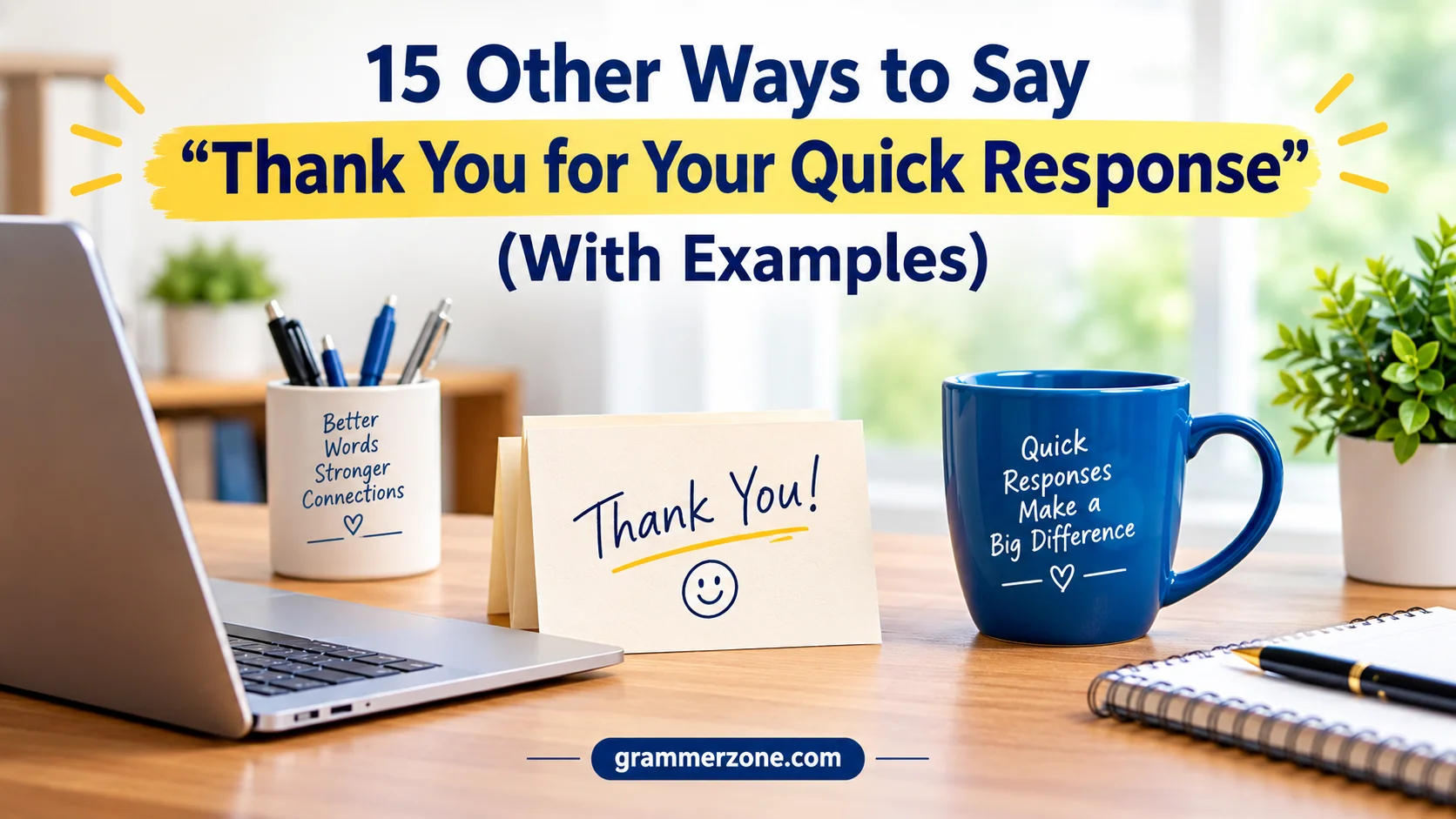
Thank You For Your Quick Response is a useful phrase for a professional communicator in the workplace. It helps express gratitude when someone has replied quickly through email correspondence, an email, message, or after a question or request. The standard expression has a clear purpose, but repeating the same common phrase every time can feel repetitive and lose its impact.
Good communication considers the words you choose and how your wording makes the other person feel. A simple thank-you can sound professional, warm, appreciative, or casual, based on the situation.You can acknowledge prompt replies while maintaining engaging and meaningful communication. The wording can include a personal touch, depending on your relationship with the reader.
From my experience, using alternative ways to show thanks can make an expression sound more natural instead of routine. Your context and level of formality can guide the choice. This blog post will explore various alternatives through 15 natural alternatives, supported by explanations, usage examples, and practical examples that help you choose the right tone for each situation.
What Does “Thank You for Your Quick Response” Mean?
“Thank you for your quick response” is a polite expression used to show appreciation when someone replies to your question, request, email, message, or inquiry without taking much time. The word “quick” emphasizes that the person responded sooner than expected or within a useful amount of time. The phrase communicates both gratitude and acknowledgment of the other person’s promptness.
The expression is especially common in professional emails, customer communication, workplace messages, and formal correspondence. It can also be used in personal communication when you want to recognize that someone got back to you quickly. Depending on the situation, “response” can refer to a detailed answer, a short reply, confirmation, or any other form of communication.
The phrase doesn’t necessarily suggest that the response was helpful or satisfactory. It specifically expresses appreciation for the speed of the reply. If you also want to emphasize that the answer was useful, you may choose wording such as “I appreciate your prompt and helpful response.”
Common Situations Where “Thank You for Your Quick Response” Is Used
People commonly use this phrase after receiving a fast reply to an email, question, request, complaint, inquiry, or message. In a workplace, you might use it when a colleague quickly provides information you need for a project. A customer might use it when thanking a support representative for responding promptly to a concern.
It also works well in formal writing. For example, someone contacting a school, business, organization, landlord, service provider, or professional may use the phrase to acknowledge a timely reply. Its neutral wording makes it suitable when you want to sound appreciative without becoming overly familiar.
In everyday conversation or texting, however, the expression can sometimes feel slightly formal. A friend might naturally say, “Thanks for getting back to me so quickly!” instead. Choosing an alternative can therefore make your message sound more relaxed, warmer, or more personal.
Is It Professional or Polite to Say “Thank You for Your Quick Response”?
Yes. “Thank you for your quick response” is polite, professional, and widely appropriate in written communication. It acknowledges the other person’s effort and shows that you noticed how promptly they replied. It works particularly well in emails where you want to maintain a respectful but straightforward tone.
The phrase is relatively neutral and formal, so it fits professional relationships better than highly casual expressions. In a message to a close friend, partner, or family member, something like “Thanks for getting back to me so quickly” may sound more natural. In a business email, “I appreciate your prompt response” may provide a slightly more polished tone.
The wording also avoids sounding overly emotional. That can be an advantage when communicating with someone you don’t know well. If your relationship calls for greater warmth, though, a more personal alternative may communicate your appreciation more effectively.
Advantages and Disadvantages of Saying “Thank You for Your Quick Response”
Advantages
The biggest advantage is clarity. The phrase immediately tells the recipient what you appreciate: the speed of their reply. It is also polite and professional without being excessively formal. You can use it in emails, customer service exchanges, workplace communication, and many other situations without worrying that it sounds inappropriate.
Another benefit is its neutral tone. It doesn’t assume that the recipient went above and beyond; it simply acknowledges that they responded quickly. That makes it useful when you want to express appreciation without exaggerating your reaction.
Disadvantages
The phrase can become repetitive if you use it frequently in professional emails. It may also sound somewhat standard or formulaic, especially when used repeatedly with the same colleagues or customers.
“Quick response” focuses mainly on speed, so it may not fully express what you actually appreciate. If the person provided a thoughtful answer, solved a problem, or made an extra effort, a phrase such as “I really appreciate you getting back to me so quickly” may sound more personal. Likewise, a casual relationship may call for less formal wording.
15 Synonyms and Alternatives for “Thank You for Your Quick Response”
- Thank you for getting back to me so quickly
- I appreciate your prompt response
- Thanks for getting back to me so quickly
- I appreciate your quick reply
- Thank you for your prompt reply
- Thanks for the speedy reply
- I appreciate the fast response
- Thank you for responding so quickly
- I appreciate you getting back to me so quickly
- Thank you for the swift response
- Thanks for the quick turnaround
- I’m grateful for your prompt response
- Thanks for responding so promptly
- Many thanks for your prompt reply
- Thanks for the timely response
These expressions are not all exact synonyms in every situation. Some are more formal, some more conversational, and others emphasize timing, efficiency, or personal appreciation. The best choice depends on your relationship with the recipient and the setting in which you are communicating.
1. Thank you for getting back to me so quickly
Meaning
“Thank you for getting back to me so quickly” means you appreciate someone replying to your previous message, question, or request in a short amount of time. It emphasizes both responsiveness and speed.
Definition
A polite way to thank someone for replying promptly to a previous communication.
Detailed Explanation
This expression is slightly more conversational than “Thank you for your quick response.” The phrase “getting back to me” sounds natural in everyday English and professional conversation alike. It works particularly well when you initiated the conversation and the other person has now replied. Compared with the original phrase, it feels a little more personal and less formulaic.
Scenario Examples
Scenario: You emailed a coworker about a deadline, and they replied within minutes.
Example: “Thank you for getting back to me so quickly. That clears up the deadline.”
Scenario: You contacted a service provider about an appointment.
Example: “Thank you for getting back to me so quickly. Tuesday afternoon works perfectly.”
Best Use
Best for emails, workplace communication, customer messages, and everyday conversations where you want to sound polite but natural.
Tone
Tone: Warm, polite, conversational
The wording feels appreciative without sounding overly formal.
2. I appreciate your prompt response
Meaning
“I appreciate your prompt response” expresses gratitude for someone replying quickly and efficiently. It places slightly more emphasis on professional appreciation.
Definition
A formal or professional way to thank someone for responding without unnecessary delay.
Detailed Explanation
This is one of the most polished alternatives to the original phrase. The adjective “prompt” is especially common in business and formal communication because it suggests timely action. “I appreciate” can also sound slightly more refined than “thank you.” Choose this expression when you want your message to feel professional, respectful, and concise.
Scenario Examples
Scenario: A client responds quickly to a request for approval.
Example: “I appreciate your prompt response and will proceed with the next step.”
Scenario: A university administrator replies to your question.
Example: “I appreciate your prompt response regarding the enrollment requirements.”
Best Use
Best for professional emails, business correspondence, formal requests, and customer communication.
Tone
Tone: Professional, respectful, polished
The wording is formal enough for workplace and institutional communication while remaining friendly.
3. Thanks for getting back to me so quickly
Meaning
“Thanks for getting back to me so quickly” is a casual version of thanking someone for replying promptly.
Definition
A friendly expression used to appreciate a fast reply to a previous message or request.
Detailed Explanation
This version sounds more relaxed than “Thank you for your quick response.” The use of “thanks” instead of “thank you” makes it less formal, while “getting back to me” creates a conversational feel. It’s especially useful when you already have a comfortable relationship with the recipient. In a formal letter, however, another alternative may be more suitable.
Scenario Examples
Scenario: A friend answers your question almost immediately.
Example: “Thanks for getting back to me so quickly! I needed that information.”
Scenario: A familiar coworker replies to your Slack message.
Example: “Thanks for getting back to me so quickly. I’ll update the document now.”
Best Use
Best for texting, instant messaging, friendly workplace communication, and casual emails.
Tone
Tone: Friendly, casual, appreciative
It sounds natural without being overly informal.
4. I appreciate your quick reply
Meaning
“I appreciate your quick reply” means you are grateful that someone responded quickly to your communication.
Definition
A concise expression of appreciation for receiving a fast reply.
Detailed Explanation
This phrase keeps the original meaning while replacing “response” with the more conversational “reply.” It is direct and easy to understand. It can work in professional settings, although it feels slightly less formal than “I appreciate your prompt response.” It is a useful choice when you want to be appreciative without adding unnecessary words.
Scenario Examples
Scenario: A colleague quickly confirms a meeting time.
Example: “I appreciate your quick reply. I’ll see you at 10 a.m.”
Scenario: Someone answers a question through email.
Example: “I appreciate your quick reply and the additional information.”
Best Use
Best for emails, workplace messages, customer communication, and general written communication.
Tone
Tone: Polite, concise, professional
The expression is straightforward and works well when you want to keep your message brief.
5. Thank you for your prompt reply
Meaning
“Thank you for your prompt reply” thanks someone for responding quickly, with “prompt” highlighting that the reply arrived within an appropriate or expected time.
Definition
A polite and professional expression used to acknowledge a timely reply.
Detailed Explanation
This is a strong choice for formal correspondence. “Prompt” can suggest more than mere speed; it can imply that the person responded without unnecessary delay. The phrase is slightly more formal than “Thank you for your quick response,” making it suitable for business letters, official emails, and professional requests. It doesn’t necessarily express warmth, but it communicates clear appreciation.
Scenario Examples
Scenario: A company representative responds to your inquiry.
Example: “Thank you for your prompt reply. I appreciate the clarification.”
Scenario: A professor responds to an academic question.
Example: “Thank you for your prompt reply. I’ll follow the instructions you provided.”
Best Use
Best for formal emails, business letters, academic communication, and official correspondence.
Tone
Tone: Formal, polite, respectful
Its wording creates a professional impression without sounding cold.
6. Thanks for the speedy reply
Meaning
“Thanks for the speedy reply” expresses appreciation for an especially fast response.
Definition
A casual way to thank someone for replying very quickly.
Detailed Explanation
The word “speedy” gives this expression a more relaxed and lively character. It can suggest that the person responded faster than expected. Because of its conversational feel, it generally works better in informal communication than in highly formal business writing. It can also add a touch of friendliness to an otherwise routine message.
Scenario Examples
Scenario: A friend answers a message almost immediately.
Example: “Thanks for the speedy reply! That was exactly what I needed.”
Scenario: A familiar colleague quickly sends you a file.
Example: “Thanks for the speedy reply and for sending the attachment.”
Best Use
Best for casual emails, texting, friendly workplace messages, and personal communication.
Tone
Tone: Casual, upbeat, friendly
“Speedy” makes the message feel lighter and more conversational.
7. I appreciate the fast response
Meaning
“I appreciate the fast response” communicates gratitude for receiving an answer quickly.
Definition
A direct expression of appreciation for a rapid response.
Detailed Explanation
This phrase is simple and efficient. It focuses clearly on response time without adding emotional intensity. Compared with “I appreciate your prompt response,” it sounds somewhat more conversational and less formal. It can be useful when you want professional wording that still feels straightforward.
Scenario Examples
Scenario: A support representative answers your question quickly.
Example: “I appreciate the fast response. The instructions solved the issue.”
Scenario: A colleague responds to an urgent work request.
Example: “I appreciate the fast response. We can move forward with the presentation.”
Best Use
Best for workplace communication, customer support, emails, and straightforward professional messages.
Tone
Tone: Professional, direct, appreciative
The wording is efficient and avoids unnecessary formality.
8. Thank you for responding so quickly
Meaning
“Thank you for responding so quickly” thanks someone directly for taking the time to answer or react promptly.
Definition
A polite expression recognizing that someone responded in a short amount of time.
Detailed Explanation
This wording uses the verb “responding” rather than the noun “response,” which can make the sentence feel more active and conversational. It works well when the recipient has taken action in response to your message. The phrase is flexible enough for both personal and professional communication. It can also sound warmer than a highly formal expression because it focuses on the person’s action.
Scenario Examples
Scenario: A manager quickly answers a question before a meeting.
Example: “Thank you for responding so quickly. I’ll make the necessary changes.”
Scenario: A friend answers a message while traveling.
Example: “Thank you for responding so quickly. I hope your trip is going well.”
Best Use
Best for emails, personal messages, workplace communication, and everyday conversation.
Tone
Tone: Warm, polite, flexible
It fits many relationships without sounding excessively formal.
9. I appreciate you getting back to me so quickly
Meaning
“I appreciate you getting back to me so quickly” shows personal gratitude for someone taking the time to reply promptly.
Definition
A warm expression that thanks a person for responding quickly to a previous communication.
Detailed Explanation
This expression is more personal and relationship-focused than “I appreciate your prompt response.” By mentioning “you,” it draws attention to the person rather than simply the response itself. It can therefore sound warmer and more sincere. It is especially useful when someone has made an effort to answer your question or help you move forward.
Scenario Examples
Scenario: A mentor quickly answers an important question.
Example: “I appreciate you getting back to me so quickly. Your advice was really helpful.”
Scenario: A customer service employee responds promptly to a concern.
Example: “I appreciate you getting back to me so quickly and explaining the next steps.”
Best Use
Best for personal emails, professional relationships, customer communication, and appreciative messages.
Tone
Tone: Warm, sincere, appreciative
The direct reference to the person makes the gratitude feel more personal.
10. Thank you for the swift response
Meaning
“Thank you for the swift response” expresses gratitude for a response that came quickly, with “swift” emphasizing speed.
Definition
A formal expression used to thank someone for responding rapidly.
Detailed Explanation
“Swift” is a little more elevated than “quick” and can give the sentence a polished tone. It is grammatically natural, although it is less common in everyday conversation than “quick” or “prompt.” Because of that, it can work well when you want formal or carefully worded communication. It may feel slightly more deliberate than the original expression.
Scenario Examples
Scenario: A business partner responds quickly to a formal inquiry.
Example: “Thank you for the swift response. We can now finalize the agreement.”
Scenario: An organization answers a time-sensitive request.
Example: “Thank you for the swift response to our inquiry.”
Best Use
Best for formal emails, business correspondence, official communication, and polished written English.
Tone
Tone: Formal, polished, respectful
“Swift” gives the expression a slightly elevated written style.
11. Thanks for the quick turnaround
Meaning
“Thanks for the quick turnaround” thanks someone for completing and returning something quickly, rather than simply replying to a message.
Definition
A workplace expression used to appreciate the fast completion or return of a task, request, document, or project.
Detailed Explanation
This expression is related to the original phrase but is not an exact substitute in every situation. “Turnaround” usually refers to the time needed to complete, process, or return something. For example, you might use it after someone reviews a document and sends it back within an hour. It’s particularly common in professional settings.
Scenario Examples
Scenario: A colleague reviews a report and returns it the same afternoon.
Example: “Thanks for the quick turnaround on the report. Your edits were very helpful.”
Scenario: A designer sends revised materials sooner than expected.
Example: “Thanks for the quick turnaround. The updated graphics look great.”
Best Use
Best for workplace communication, project management, business emails, and task-related messages.
Tone
Tone: Professional, appreciative, efficient
It sounds natural when discussing completed work or a business process.
12. I’m grateful for your prompt response
Meaning
“I’m grateful for your prompt response” expresses stronger personal appreciation for someone who replied quickly.
Definition
A warm and respectful expression of gratitude for a timely response.
Detailed Explanation
The word “grateful” carries more emotional warmth than “appreciate.” This makes the phrase useful when the response was especially meaningful, helpful, or important to you. It can still work professionally, but it may feel more personal than a standard business phrase. Use it when you want your appreciation to sound genuine rather than merely routine.
Scenario Examples
Scenario: Someone quickly responds during an important situation.
Example: “I’m grateful for your prompt response and your willingness to help.”
Scenario: A professional contact gives you information you urgently needed.
Example: “I’m grateful for your prompt response. It allowed me to complete the application on time.”
Best Use
Best for meaningful professional messages, personal communication, formal thank-you notes, and situations where genuine appreciation matters.
Tone
Tone: Warm, sincere, respectful
“Grateful” gives the message greater emotional depth than a standard thank-you.
13. Thanks for responding so promptly
Meaning
“Thanks for responding so promptly” thanks someone for taking quick action after receiving your message.
Definition
A friendly expression that recognizes a person’s timely response.
Detailed Explanation
This phrase combines the casual “thanks” with the more formal adverb “promptly.” As a result, it sits comfortably between casual and professional language. It works especially well when you want to sound appreciative but not overly formal. The wording also emphasizes the person’s action rather than simply labeling the reply as “quick.”
Scenario Examples
Scenario: A coworker responds quickly to a scheduling question.
Example: “Thanks for responding so promptly. Thursday works for me.”
Scenario: A customer replies quickly with the information you requested.
Example: “Thanks for responding so promptly and confirming the order details.”
Best Use
Best for work emails, friendly professional messages, customer communication, and everyday written English.
Tone
Tone: Polite, friendly, moderately professional
It balances conversational warmth with professional courtesy.
14. Many thanks for your prompt reply
Meaning
“Many thanks for your prompt reply” expresses sincere appreciation for receiving a timely response.
Definition
A polite and somewhat formal way to thank someone for replying quickly.
Detailed Explanation
“Many thanks” is warmer than a bare “thanks” while still fitting professional correspondence. The expression has a traditional written style, so it may sound more natural in an email or letter than in casual texting. “Prompt reply” clearly communicates that timing is what you appreciate. It’s a good choice when you want your message to sound courteous and polished.
Scenario Examples
Scenario: A professional contact quickly provides requested details.
Example: “Many thanks for your prompt reply. The information is exactly what I needed.”
Scenario: You receive a quick response from an organization.
Example: “Many thanks for your prompt reply to my inquiry.”
Best Use
Best for formal emails, business correspondence, letters, professional requests, and courteous written communication.
Tone
Tone: Polite, formal, gracious
The phrase sounds considerate and slightly more traditional than everyday alternatives.
15. Thanks for the timely response
Meaning
“Thanks for the timely response” expresses appreciation for a reply that arrived within a useful, appropriate, or expected period.
Definition
A professional expression used to thank someone for responding within an appropriate timeframe.
Detailed Explanation
The word “timely” is subtly different from “quick.” It doesn’t necessarily mean extremely fast; it means the response came when it was needed or appropriate. That distinction makes this phrase useful when speed itself isn’t the main point. For example, a response received the next day may be timely if that was a reasonable deadline.
Scenario Examples
Scenario: A colleague sends information before a scheduled meeting.
Example: “Thanks for the timely response. I’ll include those figures in the presentation.”
Scenario: A business responds before an important deadline.
Example: “Thanks for the timely response to our request.”
Best Use
Best for professional emails, workplace communication, business correspondence, and deadline-related situations.
Tone
Tone: Professional, measured, appreciative
“Timely” sounds less focused on raw speed and more focused on meeting the right timeframe.
See also: 15 Other Ways to Say “I hope you are doing well” (With Examples)
FAQs:
What is another way to say “Thank You for Your Quick Response”?
Natural alternatives include “Thank you for getting back to me so quickly,” “I appreciate your prompt response,” and “Thank you for your prompt reply.” For casual communication, “Thanks for getting back to me so quickly” sounds natural. For formal or professional writing, “I appreciate your prompt response” is a polished option.
What does “Thank You for Your Quick Response” mean?
It means you appreciate someone replying to your message, question, or request quickly. The phrase specifically recognizes the speed or promptness of the response. It is commonly used in emails, workplace communication, customer service, and other polite exchanges.
Is “Thank You for Your Quick Response” professional?
Yes. “Thank you for your quick response” is professional and polite and can be used in many workplace and business situations. However, “I appreciate your prompt response” or “Thank you for your prompt reply” may sound slightly more formal and polished.
What is a more polite way to say “Thank You for Your Quick Response”?
The original phrase is already polite. If you want a warmer version, try “I appreciate you getting back to me so quickly.” If you want a more formal expression, “I appreciate your prompt response” works well.
Which alternative works best in formal communication?
For formal communication, “I appreciate your prompt response” and “Thank you for your prompt reply” are particularly suitable. They are concise, respectful, and clearly communicate appreciation without sounding overly casual. The best choice still depends on the relationship and purpose of the message.
Conclusion:
Choosing the right expression can make a simple thank-you feel more natural, thoughtful, and appropriate. “Thank you for your quick response” is already a clear and professional phrase, but alternatives can help you adjust the tone to suit the situation. “I appreciate your prompt response” works well in formal communication, while “Thanks for getting back to me so quickly” feels more conversational. Other expressions, such as “Thanks for the quick turnaround” or “Thanks for the timely response,” add more specific meaning depending on what you appreciate. The key is to consider the relationship, context, formality, and reason for your gratitude before choosing your wording. A small change in phrasing can make your message sound much more genuine.











1 thought on “15 Other Ways to Say “Thank You for Your Quick Response” (With Examples)”