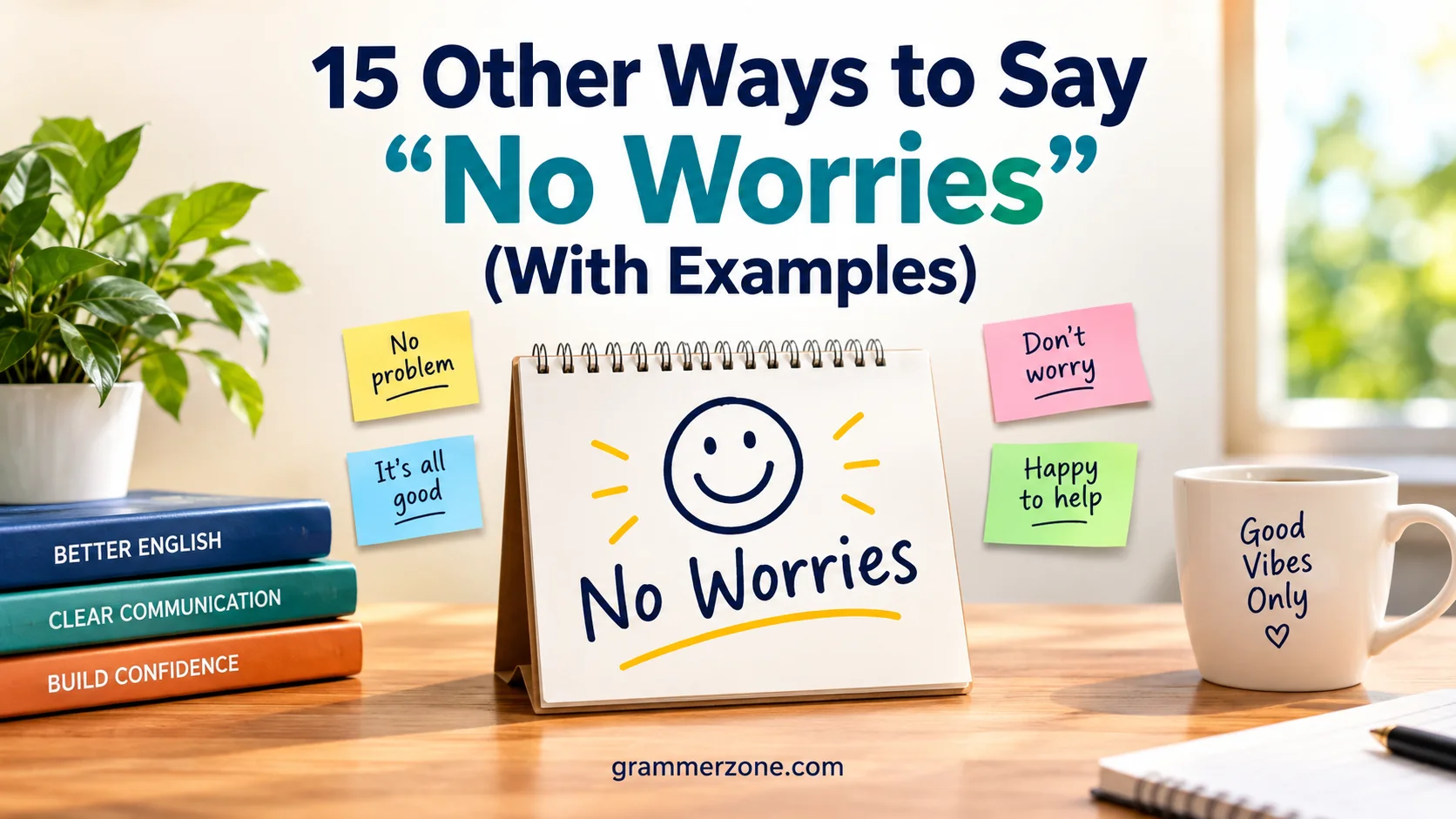
No Worries works well in daily conversations as a common response when you want to express that you’re happy to help and the request wasn’t inconvenient. The phrase can reassure someone after an apology, show that a problem isn’t a problem, and help someone feel comfortable. Saying it repeatedly can make your speech sound monotonous, so variety in your wording creates a polite tone.
Build a repertoire of alternative expressions and natural alternatives to say something that sounds warmer, sounds more professional, sounds more casual, or sounds more reassuring. The context, situation, and tones behind your words matter when you choose the right expression. You can accept an apology, show you’re ready to help, or explain that a request causes no trouble. Communication isn’t only about what you say; it also depends on how your words make someone feel.
This guide offers 15 different ways, meanings, examples, and practical advice for using these expressions. Each expression has subtle differences you can understand through context. Professional, casual, warmer, and reassuring choices can keep daily conversations fresh. A useful blog post should make the response feel thoughtful and natural, drawing from personal experience where useful.
What Does “No Worries” Mean?
No worries is a common informal expression used to tell someone that something is not a problem. It can be a response to an apology, a request, a thank-you, or a minor inconvenience. For example, if someone says, “Sorry I’m late,” you might respond, “No worries,” meaning that their lateness does not bother you. Likewise, if someone thanks you for helping them, “No worries” can mean “You’re welcome” or “It was no trouble.”
The phrase usually communicates reassurance, friendliness, and acceptance. Its exact meaning depends on context. In everyday conversation, it often sounds relaxed and approachable. In professional communication, it can still be perfectly acceptable, particularly in friendly workplaces, although a more formal expression may sometimes fit better.
Common Situations Where “No Worries” Is Used
People commonly use No Worries in casual conversations, text messages, social media exchanges, and personal communication. It works especially well when someone apologizes for a small mistake, thanks you for something, or asks whether a minor inconvenience is acceptable. A friend might say, “Sorry, I forgot to call,” and you could simply answer, “No worries.”
The phrase also appears in workplace communication, particularly when colleagues have an informal relationship. However, customer communication, formal emails, or sensitive situations may call for more precise wording. An alternative can make your response sound more professional, empathetic, or reassuring without changing the basic message.
Is It Professional or Polite to Say “No Worries”?
No worries is polite and friendly, but it is generally considered casual rather than highly formal. It can work naturally in everyday workplace conversations, internal messages, and relaxed professional environments. For example, replying “No worries, I’ll send that over this afternoon” to a colleague can sound perfectly natural.
For formal emails, customer service, official correspondence, or situations where you want to emphasize respect, expressions such as “You’re very welcome,” “Not at all,” or “I’d be happy to help” may be more suitable. The phrase itself isn’t inherently rude or unprofessional. Its appropriateness depends on the relationship, setting, and tone you want to establish.
Advantages and Disadvantages of Saying “No Worries”
Advantages
The biggest advantage of No Worries is its simplicity. It is short, friendly, and immediately reassuring. It can reduce tension after a minor mistake and make conversations feel relaxed. Because the expression is flexible, you can use it after an apology, in response to a request, or after someone thanks you.
It also avoids making a small issue feel more serious than it needs to be. If a friend apologizes for being five minutes late, “No worries” acknowledges the apology without creating unnecessary drama.
Disadvantages
The phrase can sometimes sound too casual for formal correspondence or customer-facing communication. It may also feel slightly impersonal when someone needs stronger emotional reassurance. For example, a person dealing with a serious problem may benefit from “I understand” or “Please don’t worry about it” rather than a quick “No worries.”
Because it is so common, repeated use can also make your communication feel predictable. Choosing a more specific expression can show greater empathy, appreciation, or professionalism.
15 Alternatives to “No Worries”
- No Problem
- You’re Welcome
- Not at All
- Don’t Worry About It
- It’s All Good
- That’s Okay
- It’s Fine
- No Trouble
- My Pleasure
- Of Course
- Absolutely
- I Understand
- Happy to Help
- No Need to Apologize
- Please Don’t Worry
1. No Problem
Meaning
No Problem tells someone that a request, mistake, delay, or inconvenience does not cause difficulty for you. It is one of the closest everyday alternatives to No Worries.
Definition
No Problem means that something is acceptable, manageable, or not troublesome.
Detailed Explanation
This expression is direct and versatile. You can use it when someone apologizes, asks for a favor, or thanks you for doing something. Compared with “No Worries,” it can sound slightly more matter-of-fact while still being friendly. It works particularly well when you want to reassure someone without adding emotional weight to the conversation.
Scenario Examples
Scenario: A friend apologizes for forgetting to bring something.
Example: “No problem. We can pick one up on the way.”
Scenario: A coworker asks if you can send a document later.
Example: “No problem. I’ll send it after lunch.”
Scenario: Someone thanks you for holding the door.
Example: “No problem!”
Best Use
Use No Problem in casual conversations, workplace chats, text messages, and everyday requests. It is especially useful when you want a short, natural response.
Tone
Tone: Friendly, casual, direct. It reassures the other person without sounding overly emotional.
2. You’re Welcome
Meaning
You’re Welcome is primarily a response to someone who has thanked you. It can replace “No Worries” when the intended meaning is “I was happy to help.”
Definition
You’re Welcome means that the speaker acknowledges someone’s thanks and indicates that their help or action was willingly given.
Detailed Explanation
Unlike “No Worries,” this expression specifically responds to gratitude rather than every kind of inconvenience. It is widely understood and suitable in both casual and professional settings. The phrase can sound warm and courteous without being overly formal. When someone says “Thanks for your help,” “You’re welcome” is a clearer response than “No Worries.”
Scenario Examples
Scenario: A colleague thanks you for reviewing a report.
Example: “You’re welcome. I’m glad I could help.”
Scenario: A friend thanks you for giving them a ride.
Example: “You’re welcome! Anytime.”
Best Use
Use it after thank-you messages, conversations, emails, and professional interactions where you want to acknowledge appreciation.
Tone
Tone: Polite, friendly, courteous. It has a broader professional range than many casual alternatives.
3. Not at All
Meaning
Not at All tells someone that something caused no inconvenience or that an apology is unnecessary.
Definition
Not at All means “certainly not” or “it was no trouble.”
Detailed Explanation
This expression can sound more polished than “No Worries.” It works especially well after an apology or when someone expresses concern about inconveniencing you. In British English and formal conversational English, it can sound particularly natural. It provides reassurance while maintaining a courteous tone.
Scenario Examples
Scenario: A guest apologizes for asking another question.
Example: “Not at all. Please feel free to ask.”
Scenario: A colleague apologizes for interrupting.
Example: “Not at all. I was just taking a break.”
Best Use
Use Not at All in polite conversation, professional communication, customer interactions, and situations where you want a slightly more refined response.
Tone
Tone: Polite, calm, respectful. It feels more formal than “No Worries” without becoming stiff.
4. Don’t Worry About It
Meaning
Don’t Worry About It reassures someone that they should not feel concerned about a particular mistake, inconvenience, or problem.
Definition
Don’t Worry About It means “There is no need for you to be concerned.”
Detailed Explanation
This phrase is particularly useful when someone feels guilty or embarrassed about something minor. It directly addresses their concern and helps reduce unnecessary anxiety. It can be warmer than “No Worries” when the other person clearly feels uncomfortable. However, your tone matters because the same words can sound dismissive if spoken impatiently.
Scenario Examples
Scenario: A friend accidentally spills a small amount of water.
Example: “Don’t worry about it. I’ll grab a towel.”
Scenario: Someone apologizes for replying late.
Example: “Don’t worry about it. I know you’ve been busy.”
Best Use
Use it in personal conversations, texting, friendly workplace chats, and reassuring situations.
Tone
Tone: Reassuring, friendly, informal. It works best when your delivery clearly communicates patience.
5. It’s All Good
Meaning
It’s All Good tells someone that everything is okay and there are no hard feelings.
Definition
It’s All Good means “Everything is fine” or “There’s no problem.”
Detailed Explanation
This expression has a relaxed, conversational feel. It is often used after a minor disagreement, mistake, misunderstanding, or inconvenience. Compared with “No Worries,” it can emphasize that the overall situation remains positive. It is less suitable for formal writing because of its strongly conversational style.
Scenario Examples
Scenario: A friend accidentally sends you the wrong address.
Example: “It’s all good. I found the place.”
Scenario: Someone worries that a small disagreement upset you.
Example: “It’s all good. We’re fine.”
Best Use
Use it in casual conversations, texts, social media messages, and friendly relationships.
Tone
Tone: Relaxed, warm, informal. It creates a sense that the issue has been put behind you.
6. That’s Okay
Meaning
That’s Okay communicates acceptance when someone apologizes or explains a minor problem.
Definition
That’s Okay means “I accept the situation, and it isn’t a serious problem.”
Detailed Explanation
This phrase is simple and versatile. It can sound gentle when spoken with a warm tone, especially when someone feels bad about a mistake. It is more neutral than “It’s All Good” and less formal than “Not at All.” Depending on context and delivery, though, it can occasionally sound restrained, so adding reassurance can make your meaning clearer.
Scenario Examples
Scenario: A classmate forgets to bring your notes.
Example: “That’s okay. You can bring them tomorrow.”
Scenario: A friend says they cannot attend dinner.
Example: “That’s okay. We’ll catch up another day.”
Best Use
Use That’s Okay for everyday conversation, personal messages, school situations, and informal workplace communication.
Tone
Tone: Gentle, neutral, reassuring. It is easy to adapt to different situations.
7. It’s Fine
Meaning
It’s Fine tells someone that you consider a situation acceptable or not serious.
Definition
It’s Fine means “The situation is acceptable and does not require concern.”
Detailed Explanation
This phrase can be a natural response to an apology or explanation. Its meaning depends heavily on tone. A warm delivery can make it reassuring, while a clipped delivery may sound annoyed or reluctant. Because of this, it is useful when the situation is genuinely minor, but it may not be the best choice when someone needs strong emotional reassurance.
Scenario Examples
Scenario: A roommate apologizes for using the last of the coffee.
Example: “It’s fine. I’ll pick up more later.”
Scenario: A coworker worries about changing a meeting time.
Example: “It’s fine. The new time works for me.”
Best Use
Use it in everyday conversation and informal workplace communication, particularly for minor issues.
Tone
Tone: Neutral, casual, context-dependent. Your voice or surrounding wording determines whether it feels warm or distant.
8. No Trouble
Meaning
No Trouble means that helping someone or dealing with a situation did not cause difficulty or inconvenience.
Definition
No Trouble means “It wasn’t difficult or inconvenient.”
Detailed Explanation
This expression is useful when someone apologizes for asking you to do something or thanks you for helping. It focuses specifically on the lack of inconvenience. It can sound natural in British English and in polite conversational settings. In some varieties of American English, “No Problem” or “No Worries” may sound more familiar.
Scenario Examples
Scenario: A neighbor thanks you for collecting a package.
Example: “No trouble. I was home anyway.”
Scenario: A customer apologizes for asking another question.
Example: “No trouble at all. What else can I help you with?”
Best Use
Use it in polite conversations, customer interactions, neighborly exchanges, and everyday communication.
Tone
Tone: Polite, helpful, understated. It emphasizes that the favor required little effort.
9. My Pleasure
Meaning
My Pleasure tells someone that you were genuinely pleased to help them.
Definition
My Pleasure means “I was happy to do that for you.”
Detailed Explanation
This phrase carries more warmth than “No Worries.” Instead of simply saying that something wasn’t a problem, it suggests that helping was enjoyable or willingly offered. It is especially effective after someone expresses gratitude. In customer service and professional settings, it can sound courteous and attentive.
Scenario Examples
Scenario: A customer thanks you for helping them find a product.
Example: “My pleasure. I’m glad you found what you needed.”
Scenario: A colleague thanks you for covering their shift.
Example: “My pleasure. I was happy to help.”
Best Use
Use it in customer service, professional conversations, polite exchanges, and situations involving gratitude.
Tone
Tone: Warm, courteous, professional. It expresses genuine willingness rather than merely dismissing an inconvenience.
10. Of Course
Meaning
Of Course can reassure someone that a request was perfectly reasonable or that you were naturally willing to help.
Definition
Of Course means “Certainly” or “Naturally, I’m willing to do that.”
Detailed Explanation
This expression is especially useful when someone thanks you for a favor or asks whether something is okay. It communicates confidence and willingness. Unlike “No Worries,” it does not necessarily focus on removing a problem; instead, it emphasizes that your help or agreement was expected and freely given. Context is important because “Of Course” can sound dismissive if delivered sharply.
Scenario Examples
Scenario: A friend thanks you for bringing dinner.
Example: “Of course! I knew you were having a busy day.”
Scenario: A colleague asks if they can borrow your charger.
Example: “Of course. Here you go.”
Best Use
Use it in friendly conversations, workplace communication, personal messages, and polite responses to requests.
Tone
Tone: Warm, confident, willing. It can be casual or professional depending on the surrounding language.
11. Absolutely
Meaning
Absolutely strongly communicates agreement, approval, or willingness.
Definition
Absolutely means “Certainly,” “definitely,” or “without hesitation.”
Detailed Explanation
This expression is not an exact synonym for “No Worries,” but it works when the intended message is strong reassurance or enthusiastic agreement. It is particularly useful when someone asks for permission or help. Its stronger tone can make your response sound confident and positive. It should not be used as a direct replacement when you specifically need to acknowledge an apology.
Scenario Examples
Scenario: A colleague asks whether you can help with a presentation.
Example: “Absolutely. Send me the slides and I’ll take a look.”
Scenario: A customer asks whether they can change an appointment.
Example: “Absolutely. Let me check the available times.”
Best Use
Use it for requests, agreement, professional communication, customer service, and enthusiastic responses.
Tone
Tone: Confident, positive, enthusiastic. It communicates willingness more strongly than “No Worries.”
12. I Understand
Meaning
I Understand shows that you recognize someone’s situation, explanation, or reason for a mistake.
Definition
I Understand means “I recognize and accept what you are explaining.”
Detailed Explanation
This expression is especially useful when the person is apologizing or explaining a difficult situation. Rather than simply saying that there is no problem, you acknowledge their perspective. It can therefore communicate more empathy than “No Worries.” However, understanding someone’s situation does not always mean that you agree with their actions, so the phrase has a slightly different function.
Scenario Examples
Scenario: An employee explains why a deadline was missed.
Example: “I understand. Thanks for explaining what happened.”
Scenario: A friend apologizes for canceling plans because of a family issue.
Example: “I understand. Take care of what you need to.”
Best Use
Use it in sensitive conversations, workplace discussions, personal communication, and situations requiring empathy.
Tone
Tone: Empathetic, calm, respectful. It is more emotionally attentive than a simple “No Worries.”
13. Happy to Help
Meaning
Happy to Help tells someone that you were willing and pleased to provide assistance.
Definition
Happy to Help means “I was glad to assist you.”
Detailed Explanation
This expression is more specific than “No Worries” because it focuses on helpfulness. It works especially well when someone thanks you for completing a task, answering a question, or providing support. It is common in professional communication and customer service because it sounds positive without being excessively formal.
Scenario Examples
Scenario: A customer thanks you for explaining how a product works.
Example: “Happy to help. Let me know if you have any other questions.”
Scenario: A coworker thanks you for fixing a spreadsheet.
Example: “Happy to help. I’m glad we got it sorted.”
Best Use
Use it in work emails, customer communication, support conversations, and professional messages.
Tone
Tone: Friendly, professional, helpful. It emphasizes your willingness to assist.
14. No Need to Apologize
Meaning
No Need to Apologize directly tells someone that you do not think their apology is necessary.
Definition
No Need to Apologize means “You have done nothing that requires an apology.”
Detailed Explanation
This expression is more specific than “No Worries.” It works best when someone is apologizing for something that you genuinely do not consider a problem. It can provide strong reassurance because it directly addresses their guilt or concern. In more serious situations, however, you should consider whether an apology actually deserves acknowledgment before dismissing it.
Scenario Examples
Scenario: A friend apologizes for taking a long time to reply.
Example: “No need to apologize. I know you’ve had a lot going on.”
Scenario: A colleague apologizes for asking for clarification.
Example: “No need to apologize. It’s a reasonable question.”
Best Use
Use it in personal conversations, supportive workplace communication, and situations where someone feels unnecessarily guilty.
Tone
Tone: Reassuring, supportive, compassionate. It directly removes the pressure to apologize.
15. Please Don’t Worry
Meaning
Please Don’t Worry reassures someone that they should not feel anxious or concerned about a situation.
Definition
Please Don’t Worry means “There is no need for you to be concerned.”
Detailed Explanation
This expression can sound warmer and more deliberate than “No Worries.” It is useful when someone is genuinely concerned rather than simply apologizing for a minor inconvenience. Adding “please” softens the instruction and makes the reassurance feel considerate. The phrase works particularly well when you want to calm someone without sounding dismissive.
Scenario Examples
Scenario: A friend worries that they have caused an inconvenience.
Example: “Please don’t worry. We can sort it out tomorrow.”
Scenario: A customer is concerned about a minor delay.
Example: “Please don’t worry. Your order is still being processed.”
Best Use
Use it in reassuring personal messages, customer communication, polite conversations, and situations involving genuine concern.
Tone
Tone: Warm, reassuring, considerate. It focuses directly on easing the other person’s concern.
See also: 15 Other Ways to Say “Meet and Greet” (With Examples)
FAQs:
What is another way to say “No Worries”?
Natural alternatives include “No Problem,” “That’s Okay,” “Not at All,” “Don’t Worry About It,” and “It’s All Good.” The best choice depends on whether you are responding to an apology, a thank-you, a request, or genuine concern.
What does “No Worries” mean?
No Worries generally means that something is not a problem or does not bother you. It can also function as a casual way to say “You’re welcome” after someone thanks you.
Is “No Worries” professional?
No Worries is polite but generally casual. It can work well in friendly workplace communication, but formal emails, official correspondence, and some customer interactions may call for expressions such as “Not at All,” “You’re Welcome,” or “My Pleasure.”
What is a more polite way to say “No Worries”?
“Not at All,” “My Pleasure,” and “You’re Welcome” can sound more polished depending on the situation. For reassurance, “Please Don’t Worry” may be a better choice when someone is genuinely concerned.
Which alternative works best in formal communication?
There is no single replacement for every formal situation. “You’re Welcome” works well after thanks, “Not at All” can respond politely to an apology or inconvenience, and “I Understand” is useful when empathy matters. Choose the expression that matches the purpose of your response.
Conclusion:
Choosing an alternative to No Worries is less about finding a perfect synonym and more about matching your words to the situation. “No Problem” keeps things simple, “My Pleasure” adds warmth, “Not at All” sounds polished, and “I Understand” gives a more empathetic response. Other expressions work better when someone needs reassurance, professional assistance, or a clear acknowledgment of their thanks.The key is to consider your relationship with the other person, the seriousness of the situation, and the tone you want to create. No Worries remains a useful everyday expression, but having several alternatives gives your communication more range.








1 thought on “15 Other Ways to Say “No Worries” (With Examples)”